Constitution guarantees religious freedom to all: Bishop Francis Serrao
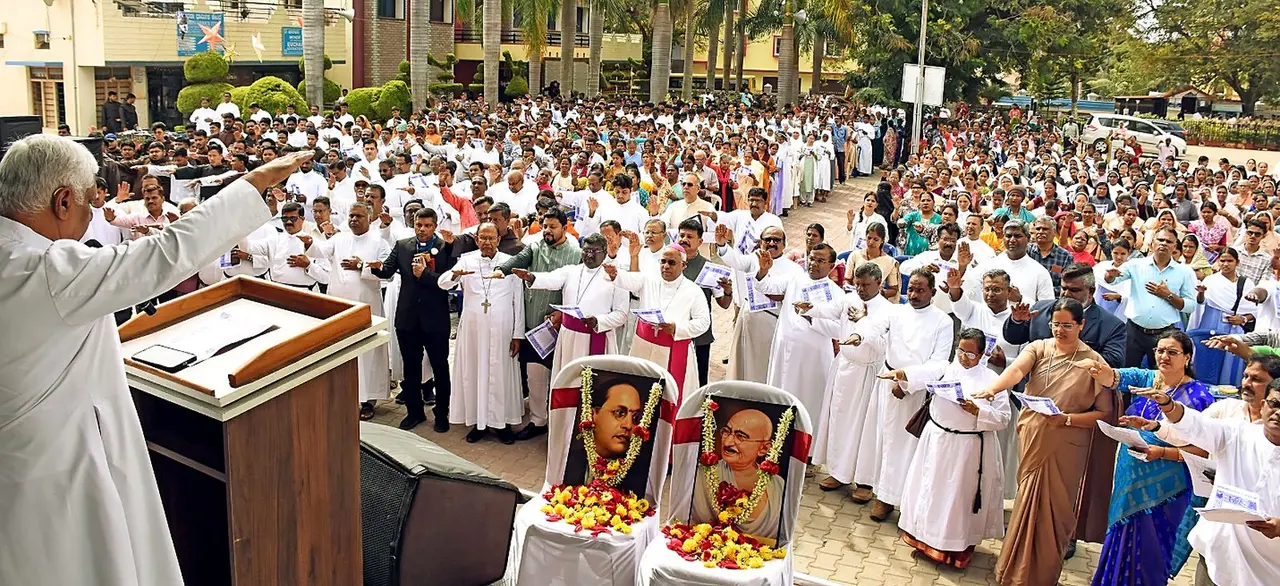
MYSURU: The Indian Constitution guarantees every individual the freedom of conscience and the right to profess, practise and propagate religion, and these rights must be respected by all, said Most Rev. Francis Serrao SJ, Bishop of the Mysore Diocese and Chairman of the United Christian Forum, Mysore.
Delivering the keynote address at the Constitution Day celebrations organised by the United Christian Forum at a church in Mysuru on Thursday, he said religious freedom was a universal constitutional right and not a privilege enjoyed by any particular community.
Referring to Article 25 of the Constitution, Bishop Serrao explained that religious freedom encompassed three essential aspects — the freedom to profess one’s faith, practise religious beliefs and propagate religion. While professing religion concerned an individual’s inner convictions, practising religion involved expressing faith through prayer, worship, rituals and traditions. Propagating religion meant sharing one’s beliefs and religious teachings with others, he said.
Clarifying the distinction between evangelism and forced religious conversion, he said influencing an individual’s religious decision through force, intimidation, deception or inducement could not be justified in the name of religious freedom. At the same time, freely expressing one’s faith or sharing religious teachings with others should not automatically be branded as forced conversion. “The difference between the two should be clearly understood by society, the administration and those implementing the law,” he observed, adding that, from a Christian perspective, faith was a free response of the heart and could never be imposed.
Emphasising the contribution of Christian institutions to society, he said educational institutions, hospitals, orphanages, social service centres and rural development initiatives had been serving people across religious, caste and linguistic boundaries for decades. Feeding the hungry, treating the sick, educating children and comforting the distressed were expressions of humanity and should not be viewed with suspicion based on religion.
Recalling the adoption of the Constitution by the Constituent Assembly on November 26, 1949, he paid tribute to Dr. B.R. Ambedkar and other members who contributed to its framing. He described justice, liberty, equality and fraternity, enshrined in the Preamble, as the four pillars of Indian democracy, stressing that the country’s strength lay in its diversity and mutual respect.
As President of the United Christian Forum, he called upon people to create constitutional awareness among the youth, safeguard religious freedom, oppose religious hatred and discrimination through democratic means, and promote dialogue and cooperation among leaders of different faiths. “Let us love our religion and respect the religion of others. Religion should not alienate people but make them more human,” he said, urging citizens to uphold the constitutional ideals of unity, dignity and fraternity.
On this occasion, R. Murthy delivered a special lecture on the Constitution. Several persons attended the function.