Honoring Mahatma Gandhi's vision on his 157th birth anniversary
Mahatma Gandhi’s 157th birth anniversary reminds modern India that true freedom demands eradicating poverty and inequality.
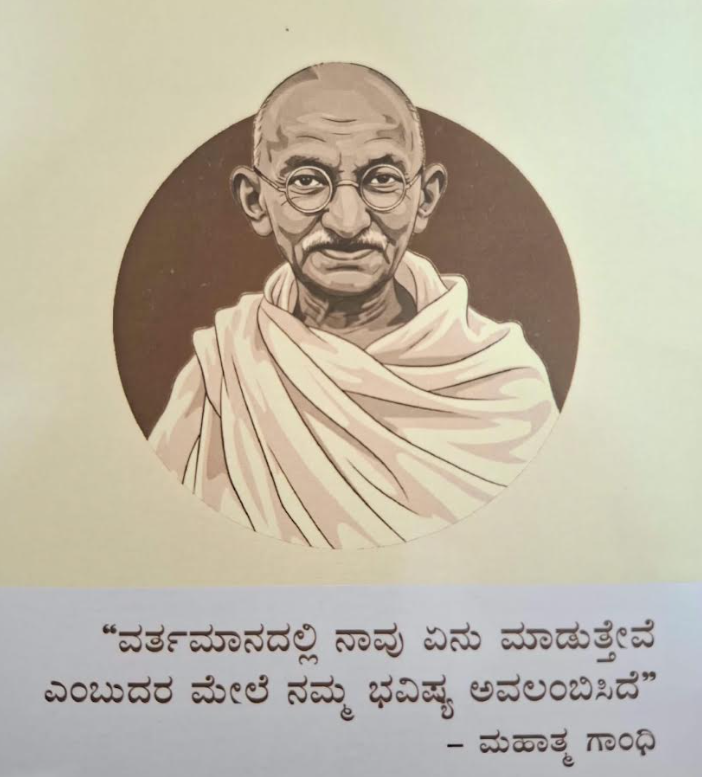
Gadag As the nation commemorates the 157th birth anniversary of Mahatma Gandhi, the timeless relevance of his philosophy offers a profound mirror to contemporary Indian society. Beyond his monumental role in securing India’s independence from British colonial rule, the Mahatma viewed political freedom as merely the first step toward true liberation. He consistently maintained that even if governance passed into Indian hands, genuine freedom would remain elusive unless systemic evils such as poverty, hunger, ignorance, social inequality, untouchability, economic exploitation, and widespread discrimination were thoroughly eradicated. Gandhi’s vision of Purna Swaraj was deeply egalitarian, rooted in the empowerment of the most vulnerable. In the ideal society of his dreams, every citizen—regardless of caste, creed, or economic standing—would possess the unalienable opportunity to live with dignity and self-respect. His concept of Sarvodaya, meaning the progressive upliftment and welfare of all, demanded that farmers, manual laborers, women, and marginalized communities participate fully as honored members of the national mainstream. Reflecting upon his legacy today reveals that while modern India has made staggering strides in technology, economic development, and global influence, much work remains to fulfill Gandhi's comprehensive socioeconomic agenda. Contemporary challenges such as structural inequality, youth unemployment, localized poverty, institutional corruption, and severe environmental degradation require the active, moral participation of every citizen. Gandhi firmly believed that nation-building is not the exclusive responsibility of elected governments; rather, it demands vigilant civic engagement, continuous self-reflection, and active grassroots participation through Gram Swaraj, or village self-rule. At the core of Gandhi's extraordinary leadership was an unyielding commitment to truth (Satya) and non-violence (Ahimsa). He famously characterized his entire life as a continuous series of "experiments with truth," demonstrating the rare courage to publicly acknowledge his own mistakes and correct them. He taught that while errant behavior is a natural human trait, attempting to conceal errors is a sign of moral weakness. Furthermore, he redefined non-violence not merely as a passive political tool against foreign oppressors, but as an active, daily spiritual practice. He argued that conquering one's own anger, practicing patience in the face of provocation, and choosing calm dialogue over harsh rhetoric represent the highest forms of inner strength. Gandhi’s personal life stood as a powerful testament to radical simplicity. To the Mahatma, simplicity was never merely an aesthetic lifestyle choice; it embodied a rigorous moral principle and a profound social message. It meant possessing only what was genuinely necessary, curbing consumerist desires, respecting manual labor, empathizing deeply with the suffering of others, and living in harmonious balance with nature's finite resources. He famously challenged individuals to measure their worth not by material possessions or accumulation of wealth, but by the positive impact of their daily contributions to society and the relief they brought to the less fortunate. As the nation honors the Father of the Nation on his 157th birth anniversary, his eternal message resonates with renewed urgency. True reverence for Gandhian philosophy does not lie in ceremonial tributes, but in personal transformation. By embracing truth, practicing non-violence, fostering social equality, and taking personal responsibility for community welfare, the present generation can actively fulfill the Mahatma's enduring dream of a free, harmonious, and truly just India.