India navigates global turbulence: FM
Economic Resilience
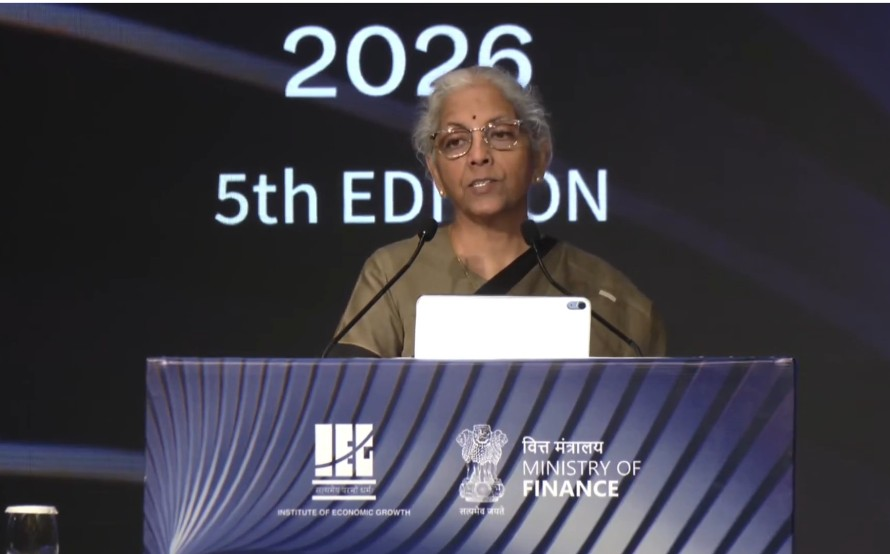
Finance Minister Nirmala Sitharaman on Saturday said India had successfully navigated a period of global economic uncertainty, including risks arising from the West Asia crisis, while maintaining its economic fundamentals. Addressing the special plenary on “Resilience in an Age of Flux: India’s Economic Priorities” at the 5th Kautilya Economic Conclave, Sitharaman said India had emerged from the period with its fundamentals intact and strengthened. She highlighted the broader challenges facing the global economy, noting that global public debt had risen to nearly 94 per cent of GDP in 2025 and was projected to reach 100 per cent by 2029. She said such conditions could leave economies with thinner buffers to absorb shocks. Sitharaman distinguished between price and quantity shocks, saying the latter could test macroeconomic systems, delivery mechanisms and the capacity of governments to respond effectively. She cited India’s recent economic indicators, including real GDP growth of 7.8 per cent in the first quarter of FY2026-27, CPI inflation of around 4.8 per cent in August 2026 and a current account deficit of 0.5 per cent of GDP in the first quarter. The Finance Minister also outlined measures undertaken since 2014 to strengthen household resilience, productive capacity and participation in economic growth. She pointed to the Jan Dhan-Aadhaar-Mobile framework and Direct Benefit Transfer for improving delivery of government assistance. Schemes including PM Awas Yojana, Swachh Bharat, Ujjwala, Ayushman Bharat and food-security measures were cited as efforts addressing household vulnerabilities. Sitharaman also highlighted PM MUDRA, which she said had sanctioned more than 52 crore collateral-free loans, along with PM SVANidhi and banking-sector reforms involving recapitalisation, stressed-asset resolution and stronger governance frameworks.